
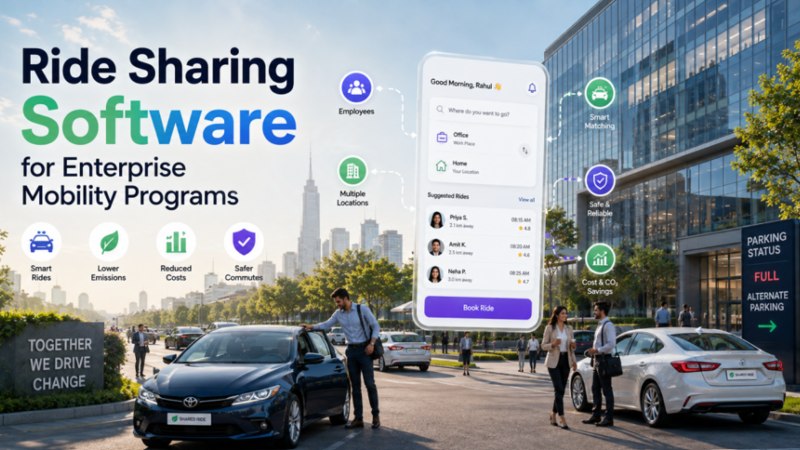
Return-to-office mandates brought people back to buildings. The commute experience stayed exactly as painful as before. Parking lots fill up by eight. Fuel prices take away from salaries, which are not even comfortable enough. Mobility solutions like ride sharing software have progressed from being an add-on feature to an integral part of enterprise mobility program infrastructure. Only a few years ago, corporate carpooling was something small and green, handled by a volunteer committee in each organization.
The Return-to-Office Commute Problem
Office attendance policies tightened across most industries over the past two years. People who organized their work routine in a way that required home offices found themselves in need of a solid plan to go to offices on a daily basis. Most people sold their second cars during the remote work period or never even owned any car.
Parking capacity stayed flat while demand surged back overnight. Many campuses built for a smaller in-office workforce now face daily overflow. Employees circle lots before meetings even start. Commute costs rose alongside everything else. Fuel prices, insurance, and vehicle maintenance all climbed together. Driving alone now costs many employees well over a thousand dollars a year more than carpooling would.
Younger employees feel this pressure especially hard. Starting salaries remained more or less the same while costs of commuting rose, making it necessary for workers to seek companies that will provide them with the proper transport. This shows which priorities the company holds, whether consciously or not. Some candidates now ask about commute benefits during final-round interviews, right alongside salary and healthcare questions.
Employee commuting also affects punctuality and focus in ways leadership regularly underestimates. A stressful hour spent in traffic changes how someone shows up to their first meeting. Structured employee commute management turns a daily source of friction into something predictable and manageable.
Regulatory and ESG Pressure Keeps Building
Government mandates around corporate mobility have grown far more common. Several countries now require companies above a certain size to adopt formal mobility plans. More jurisdictions add similar rules every year. Belgium introduced mobility budget schemes for employers. Italy requires larger companies to file mobility plans covering staff commuting patterns.
Boards increasingly expect emissions data tied to employee travel, alongside fleet vehicles and business flights. Commuting falls under broader Scope 3 emissions categories that sustainability teams now track with real scrutiny. External auditors ask pointed questions about methodology as much as the headline numbers themselves. A corporate carpooling solution that generates audit-ready emissions reports turns a compliance burden into a straightforward exercise. Finance can defend those figures in a room full of skeptics.
Employee expectations reinforce this pressure from another direction entirely. Surveys consistently show most workers want employer support for sustainable commuting. Many judge potential employers partly on environmental commitments. Recruiting teams increasingly hear this come up in interviews, sometimes directly and without much prompting.
- Government mobility mandates now apply to a growing list of countries
- Scope 3 emissions reporting increasingly includes employee commuting
- Board-level ESG reporting demands verifiable, audit-ready data
- Talent decisions increasingly factor in employer sustainability support
Why Ride Sharing Software Works Now
These pressures existed for years before software caught up. A decade ago, ride matching software relied on crude rules and static schedules. Today’s platforms weigh route, timing, and rider history together, producing matches that hold up over weeks of real commuting.
Calendar integration solved the hybrid work problem directly. Static carpool assignments made sense when everyone worked the same five days. They collapsed fast once hybrid schedules became standard practice. Modern platforms sync directly with calendar systems, confirming who is commuting each day before building that day’s pools. A Tuesday pool looks completely different from a Thursday pool, and the software handles that change without anyone lifting a finger.
Enterprise IT stopped treating mobility software as a standalone tool too. Single sign-on, HRMS syncing, and calendar APIs let rideshare platforms plug directly into existing systems. That integration depth removes the manual overhead that killed earlier carpool programs before they ever gained traction with employees.
- AI-driven matching produces durable pairings that hold up over time
- Calendar-aware scheduling accounts for real hybrid work patterns
- Deep enterprise integrations remove manual coordination work entirely
- Safety features like GPS tracking and SOS support build genuine employee trust
The Business Case Beyond Commuting
Enterprise mobility software delivers returns finance teams can measure directly. Fuel savings and reduced parking demand show up in budget reports within a single fiscal year. A workforce mobility program running efficiently frees up parking capacity that would otherwise require expensive expansion. A company adding a hundred new hires next year can absorb that growth without breaking ground on a new lot.
Retention benefits build more gradually but carry real weight over time. Employees who spend less on commuting and less time stressed in traffic report higher satisfaction scores. Employee transportation solutions offered as a genuine benefit see participation grow through word of mouth alone. Employees talk openly about programs that genuinely help them.
Risk reduction matters too, and gets discussed less often than it deserves. A carpool management system with verified profiles, route tracking, and incident logging creates documentation that informal carpool arrangements never produced. When an incident happens, whether a minor dispute or something more serious, a clear timestamped record changes the entire conversation.
What to Look for Before Adopting Ride Sharing Software
Platforms vary widely in how well they meet enterprise requirements. Evaluate deployment speed first. A rollout that drags on for months loses momentum before it reaches most employees. Confirm the matching engine handles real schedule complexity, using genuinely messy data pulled from your own organization.
Check integration depth with your existing HRMS and calendar systems. Gaps here create ongoing manual work nobody budgeted for. Request full documented methodology related to data calculation for emissions. A vendor who hesitates on that question reveals something important about the rest of the relationship.
Conclusion
This industry has matured enough to leave the companies with consequences of not implementing the solution. Pressures of returning to offices, regulations, and employees’ wishes pull toward the same goal now. All the technologies exist to satisfy these requirements together. The ones still running things through a spreadsheet and a group chat will spend the next two years catching up.